

Integrating FMEDA with Siemens EDA and Modelwise enables engineers to automate fault evaluation, shorten development cycles, and generate functional safety reports from the earliest stages of design.
When functional safety can no longer be an afterthought
As electronic systems become increasingly complex, the number of potential failure points grows. Safety-critical applications require engineers to conduct functional safety analysis to demonstrate that their designs meet or exceed applicable safety requirements and respond correctly to faults that could threaten human life, health, property, or the environment.
FMEDA (Failure Modes, Effects, and Diagnostics Analysis) is among the most widely used techniques in this field. It has roots in failure analysis methods first developed for the US military in the 1940s. However, performing FMEDA manually introduces several limitations:
- Time-consuming work: repetitive analysis tasks require considerable engineering effort.
- Inconsistent results: subjective interpretation by individual engineers increases the risk of errors and discrepancies.
- Late-stage analysis: FMEDA is often performed near the end of the design cycle, making corrective action more costly and potentially delaying development.
Modernizing FMEDA through formalization and automation
Siemens EDA has worked with Modelwise GmbH to bring formal methods and automation into the functional safety workflow. Modelwise’s Paitron solution replaces much of the manual analysis with an automated process, allowing FMEDA results to be calculated more accurately and efficiently. Fault effects are evaluated through circuit simulation and automated reasoning, reducing the time and effort required for a comprehensive safety assessment.
This allows functional safety analysis to begin earlier in the design process and be repeated as the design evolves, instead of being postponed until final verification.
Integrating HyperLynx AMS with Xpedition Designer
The workflow becomes even more effective when Paitron is combined with Siemens HyperLynx AMS, a flexible platform for circuit modeling, simulation, and analysis. HyperLynx AMS integrates with Xpedition Designer, enabling simulation models to be assigned directly to components in the schematic design environment.
A single design can therefore support schematic capture, PCB layout, modeling, and simulation. Eliminating duplicated schematics can shorten engineering cycles and reduce opportunities for errors.
Another benefit is automated bill of materials (BOM) generation using component attributes directly from the schematic database. The functional safety tool can map components to failure-rate and failure-mode database categories automatically, avoiding a particularly tedious manual process. A shared schematic-based workflow also simplifies component database maintenance and improves consistency across engineering activities. Voltage and current ratings, for example, can be carried directly into the analysis for improved accuracy.
How the integrated FMEDA workflow works in practice
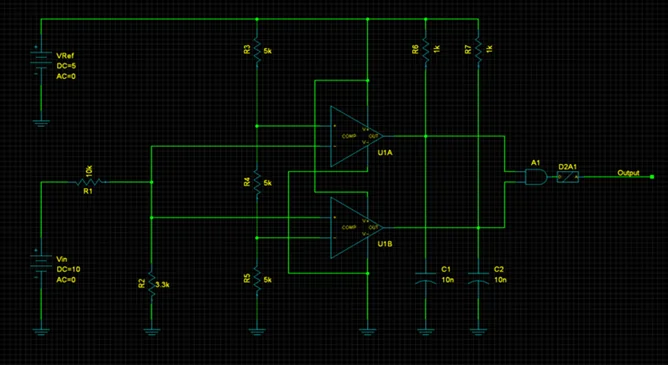
The Siemens technical white paper illustrates the integrated HyperLynx AMS–Paitron process through two electronic designs. The first is a voltage monitoring circuit. System inputs and outputs, as well as potential failure modes, are formally defined to create an objective, traceable specification and minimize ambiguity.
Component failure modes and failure rates are derived from recognized industry references including SN 29500 and IEC 61709. The corresponding faults are introduced into the simulation netlist and evaluated using HyperLynx AMS.
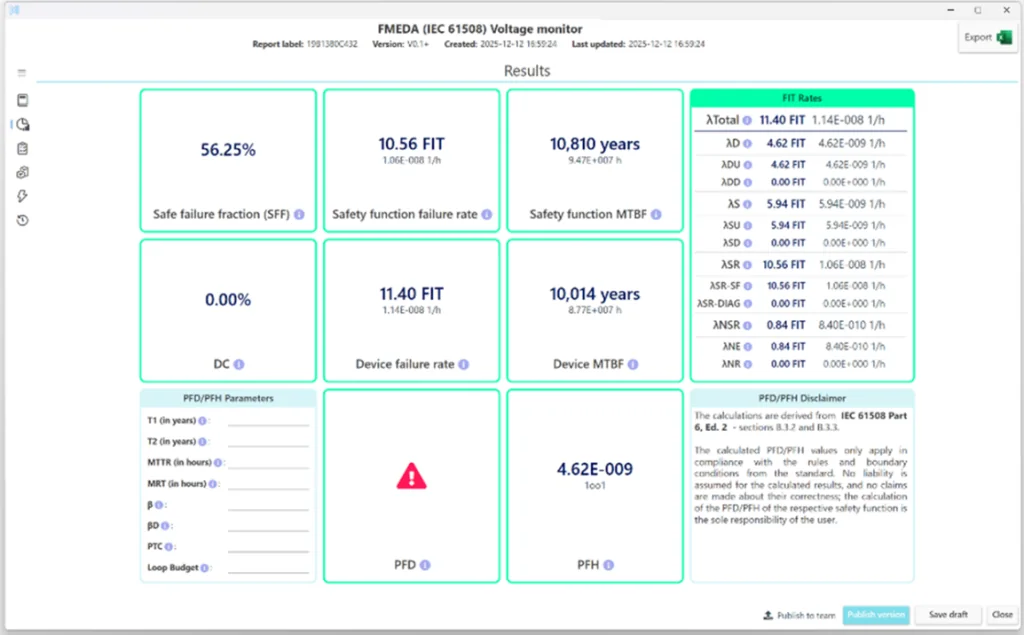
After the analysis is completed, the workflow generates a detailed safety report containing metrics associated with the selected safety standard. Under IEC 61508, the report can summarize the following functional safety key performance indicators:
| Safety metric (IEC 61508) | What it measures |
|---|---|
| Safe Failure Fraction (SFF) | Proportion of failures classified as safe or detected dangerous failures |
| Safety function failure rate | Rate at which the defined safety function fails |
| Mean Time Between Failures (MTBF) | Expected average operating time between failures |
| Probability of Failure per Hour (PFH) | Probability per hour of a dangerous failure |
A real-world PCB is often far more complex than a voltage monitor, with multiple schematic sheets and functional blocks. The second design discussed in the white paper is a power-conversion system consisting of five blocks: a rectifier, a controller, two DC–DC converters, and a voltage monitor. The complexity of each block is comparable to, or greater than, that of the first example, demonstrating the potential of the integrated approach on larger designs.
4 practical benefits of automated FMEDA
- Earlier verification: introduce functional safety analysis at the beginning of development and minimize late redesigns.
- Faster analysis: use circuit simulation and automated reasoning in place of repetitive manual steps.
- More reliable, consistent results: produce objective, traceable assessments based on actual component data from the schematic.
- A connected workflow: reuse one electronic design across schematic capture, PCB layout, simulation, and functional safety analysis.
With a more connected workflow, engineering teams can address safety considerations as part of routine development rather than as a separate final-stage task. Automation does not remove the need for engineering judgment, but it helps engineers spend more time examining design risks and less time managing repetitive analysis.
Source: Siemens Digital Industries Software.
Related articles
- From Optimization to AI: The Evolution of Intelligent PCB Analysis
- Explore Siemens Xpedition: Features, Benefits, and Editions
Contact VBTECH for more information about functional safety analysis solutions: