

For humanoid robots to move beyond the laboratory, a working prototype is only the beginning. The next challenge is to validate the design, improve it quickly and prepare it for production at scale.

Humanoid robots bring AI from digital environments into the physical world. Image source: Siemens Digital Industries Software, 2026.
Humanoid robotics is moving toward practical applications in manufacturing, logistics and environments originally designed for people. This development is closely linked to Physical AI: artificial intelligence that can perceive, interact with and act in the physical world, rather than only process information in digital systems.
From a working prototype to a commercially viable product
Teaching a robot to walk, grasp objects or complete a task is an important milestone. To deploy humanoid robots in real-world settings, however, developers must also refine their designs continuously, validate the impact of each change and find ways to scale production.
According to Siemens materials, many developers are working toward platform update cycles of approximately 12–18 months while seeking substantial reductions in bill of materials (BOM) costs to support commercial deployment. Faster design iterations, earlier validation and connected data across engineering teams are therefore becoming increasingly important.
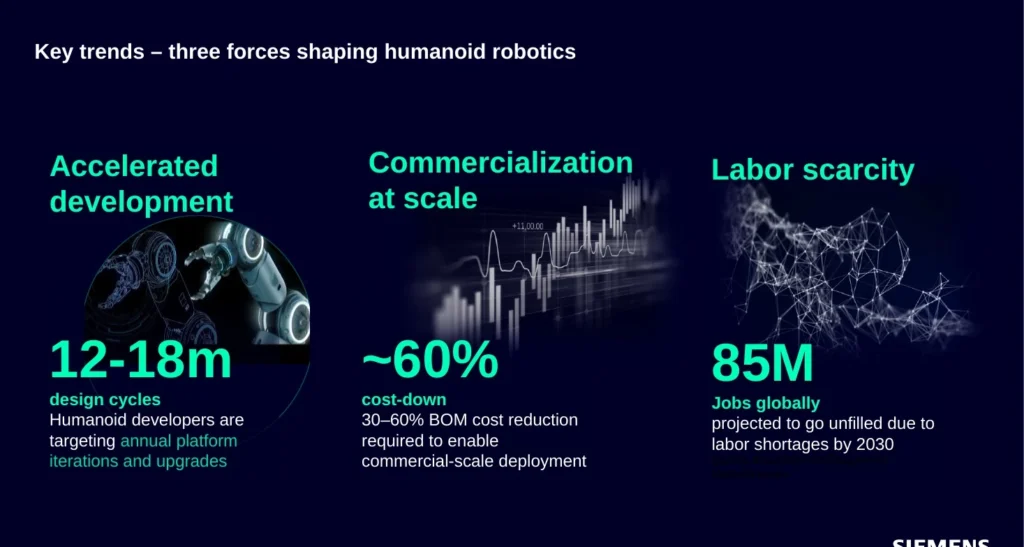
Key drivers of humanoid robotics: faster development, commercialization at scale and demand for automation. Image source: Siemens.
Digital Twin helps validate designs before a robot is built
A humanoid robot brings together mechanical components, actuators, sensors, electrical systems, batteries, controls and robotics software. When teams work with separate tools, a single CAD design change may require multiple data exports, model conversions, URDF updates and simulation runs.
Siemens’ approach is to maintain a connected Digital Thread across the Design – Validate – Optimize – Robotics process, with the Digital Twin serving as a shared foundation. Using a digital model, engineers can build the robot’s structure and evaluate its motion, workspace, payload, center of mass, joint limits and potential collisions before investing in a physical prototype.
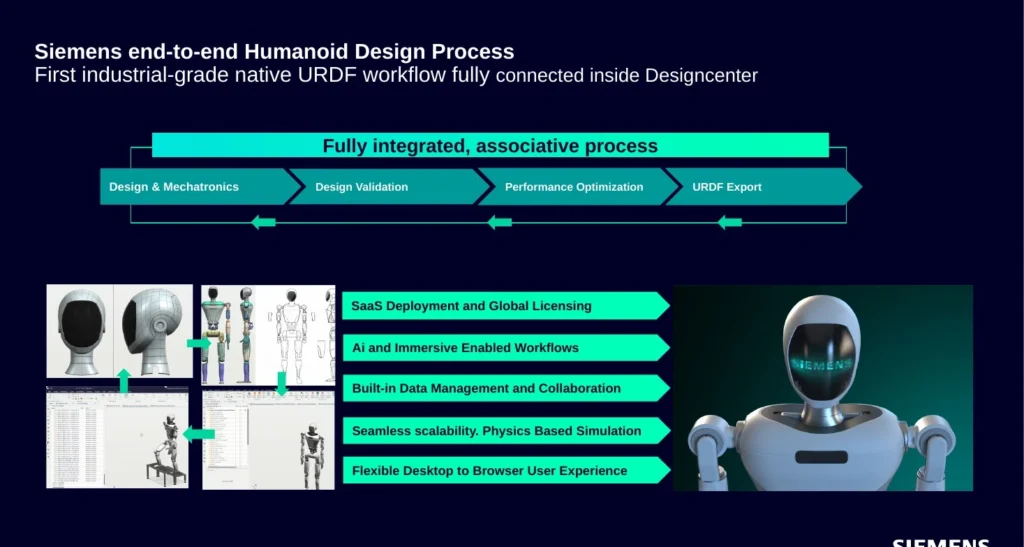
A connected humanoid design process, from mechatronics, validation and optimization to URDF export. Image source: Siemens.
Connecting design data with robotics environments
URDF provides one way to transfer a robot’s structure from the design stage into a robotics environment. A connected workflow can reduce the need to rebuild models after every CAD change, preserve design intent and limit manual steps between CAD and ROS. Development teams can then spend more time validating and optimizing the product.
Simulating earlier to reduce hardware iterations
The idea of “Prove the robot before you build it” places simulation earlier in the development process. Together, Designcenter and Simcenter support the evaluation of motion, structural behavior, thermal performance and multiphysics challenges using Digital Twin data. The goal is to identify issues in the digital model before they appear in an expensive physical prototype.
Industrialization will shape the next stage
As humanoid robots move closer to real-world applications, their advantage will depend on more than AI and mobility. Companies also need to shorten development cycles, reduce rework and connect mechanical, electrical, simulation and robotics teams within a shared process.
From Prototype to Platform. From Fragmented to Integrated. From Trial-and-Error to First-Time-Right Engineering.
Through Siemens Xcelerator, together with Designcenter, Simcenter, Teamcenter and Capital, Siemens is building a connected engineering ecosystem that spans concept development, design and Digital Twin validation through to the development of humanoid platforms suitable for production at scale.
Reference: Siemens Digital Industries Software – Designcenter for Humanoid Robotics, 2026.