

FPGA-based prototyping has evolved significantly, from systems that had to be assembled and configured manually to dedicated, ready-to-use platforms. Today, this technology has become an essential tool for SoC verification and system validation.
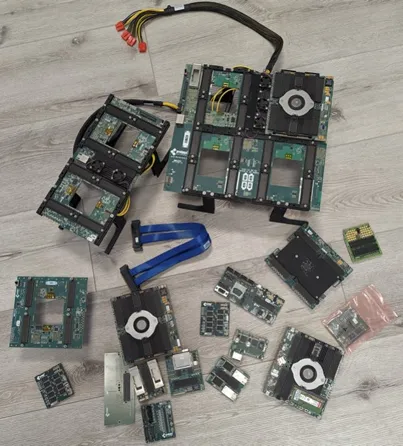
In the past, building an FPGA prototyping system required considerable time and effort. Once operational, however, it delivered significant value by enabling pre-silicon verification at speeds of tens of megahertz, reducing testing time from several days to just a few minutes.
As chip designs become more complex, software content and the volume of data exchanged within SoCs continue to grow, while product development cycles keep getting shorter. As a result, FPGA-based prototyping is playing an increasingly important role.
1. What Are the Key Components of a Modern FPGA Prototyping Platform?
A modern FPGA prototyping platform consists of three main components:
- FPGA hardware: Uses one or more FPGAs to implement the design.
- Compilation software: Takes the ASIC RTL design and maps it onto a system comprising multiple FPGAs.
- Test environment: Stimulates the design through real-world system interfaces such as sensors, cameras, and Ethernet traffic.
Together, these components create a cycle-accurate digital twin of an SoC or IP design, running fast enough to boot firmware and operating systems and execute real-world software applications.
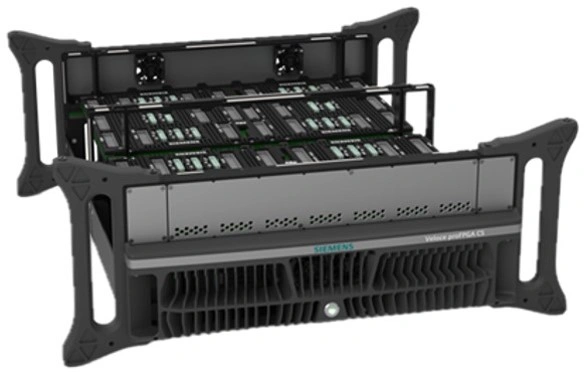
2. Siemens Veloce proFPGA CS and VPS Software
Siemens Veloce proFPGA CS provides an FPGA prototyping platform with debugging capabilities through memory backdoor access. This enables users to update boot images, monitor register and memory contents, and connect to real-world system interfaces for testing.
Alongside the hardware, Siemens provides VPS (Veloce Prototyping Software) to address the challenges of implementing designs across multiple FPGAs.
VPS supports:
- Automatic RTL conversion to make the design suitable for the FPGA architecture.
- Automatic design partitioning across multiple FPGAs and pin multiplexing insertion.
- Timing-driven performance optimization to reduce software execution time.
- Integration of debugging features into the prototyping environment.
By combining Veloce proFPGA CS hardware with VPS software, Siemens delivers a comprehensive FPGA prototyping solution that helps organizations improve the efficiency of SoC verification and system validation before silicon fabrication.
Discover more:
- Siemens Veloce proFPGA CS – Accelerating FPGA Prototyping Implementation
- Veloce – A Hardware-Assisted Verification Platform for Accelerating Chip Development
- Siemens EDA – Vietbay Partner with Leading Semiconductor Companies at SEMIEXPO Vietnam 2026
Contact VBTECH for direct consultations: