

Artificial intelligence is rapidly moving beyond computer screens and into real-world manufacturing environments. Siemens has recently announced major advances in its collaboration with NVIDIA to develop AI-powered factories, where Digital Twins, simulation, and intelligent production planning work together to accelerate manufacturing processes, optimize costs, and enable more adaptive decision-making.
According to Siemens’ announcement on October 19, 2026, new applications at its Electronics Factory in Erlangen, Germany, can reduce engineering effort by up to 85% during virtual production ramp-up and offer potential cost savings of up to 20% through AI agent-based production planning.
Can AI Run a Factory on Its Own?
For years, when businesses thought about artificial intelligence, they primarily associated it with chatbots, office automation, or data analytics. Today, however, AI is taking a major step forward: entering factories and becoming involved in simulation, production planning, manufacturing optimization, and operational support in real industrial environments.
This is precisely what Siemens has demonstrated through its collaboration with NVIDIA. At Siemens’ Electronics Factory in Erlangen, Germany, the two companies are developing AI applications integrated with Digital Twin technology to advance the concept of an Autonomous and Adaptive Factory.
This marks a significant milestone in bringing AI-driven manufacturing into practical operation, moving beyond theoretical concepts and technology demonstrations.
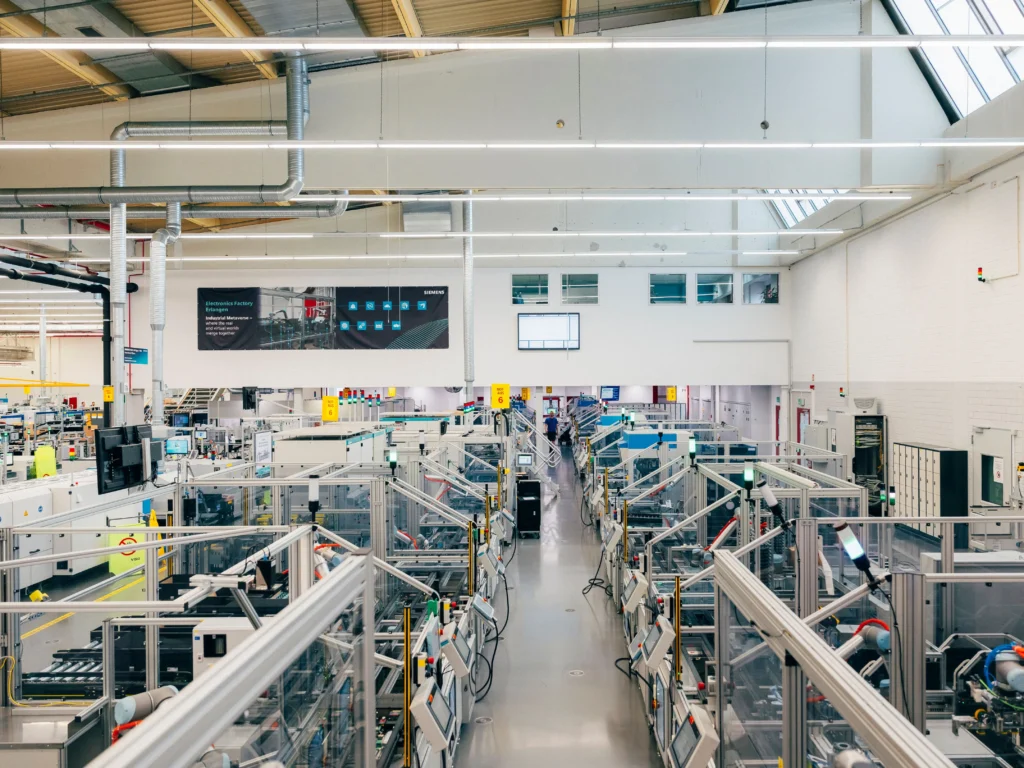
Fully automated production line at Siemens Electronics Factory in Erlangen, Germany. Source: © Siemens AG.
What Is Changing Inside the Factory?
The most remarkable development is not simply that AI is being used in factories, but how it is being integrated into specific manufacturing processes, from engineering preparation and quality inspection to operational planning.
Reducing Engineering Effort by Up to 85% Through Virtual Production Ramp-Up
One of the most notable applications is Fully Virtual Production Ramp-Up, which involves preparing and validating manufacturing processes in a digital environment before implementing them on the physical production floor.
For new printed circuit board assemblies (PCBAs), engineering teams traditionally had to wait for physical prototypes before training machine vision systems and configuring quality inspection equipment. This process could take several weeks.
By combining AI with Digital Twin technology, manufacturers can generate highly realistic synthetic images of PCB assemblies directly from digital design data. These images can then be used to prepare and train inspection systems before physical prototypes become available.
According to Siemens, this approach can reduce engineering effort by up to 85% and shorten time-to-market by up to 40% in the disclosed PCB assembly production ramp-up applications.
AI Agents Transform Production Planning
Beyond simulation, Siemens has introduced an approach to manufacturing planning known as Agent-Based Production Planning.
In conventional factories, production planners must consider numerous factors, including production line capacity, material availability, delivery schedules, and changes in customer orders. This is a complex process that requires experience and the ability to evaluate multiple production scenarios.
With AI Agents, when a new order arrives, the system can automatically generate production scenarios, analyze their potential impact against predefined key performance indicators (KPIs), and help managers identify the most suitable production plan.
Importantly, these scenarios can be validated using a Digital Twin of the entire manufacturing facility before being implemented in the physical environment.
Siemens estimates that this planning approach offers potential cost savings of up to 20%, while enabling factories to respond more flexibly to new orders, material shortages, and changing customer requirements.
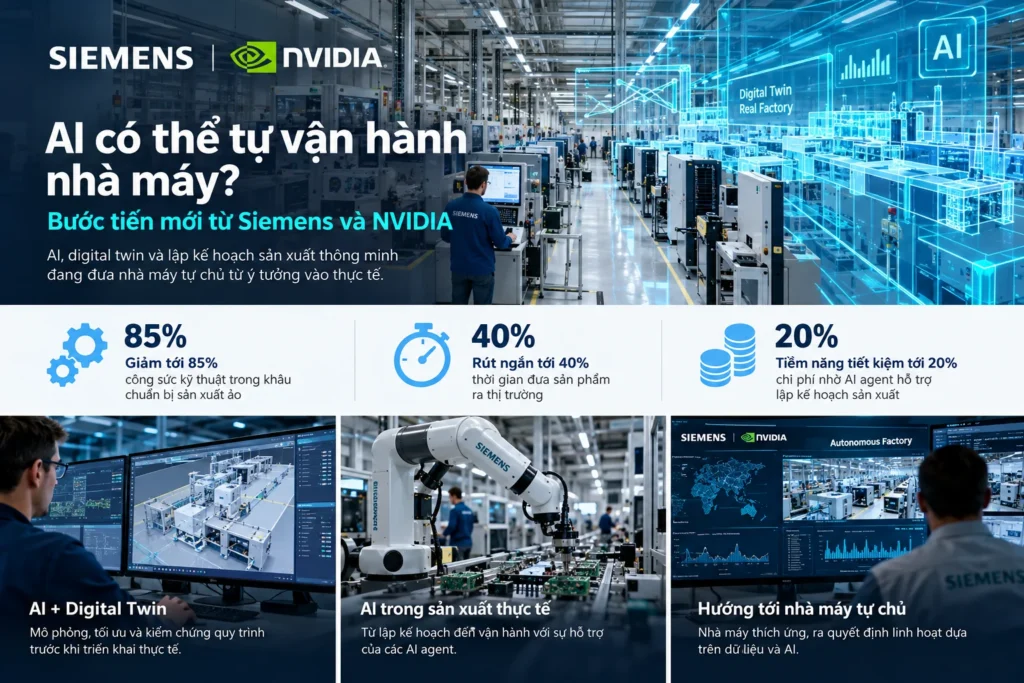
Key benefits of AI and Digital Twin applications in manufacturing, based on Siemens’ announced figures. Illustration: VBTECH.
From Smart Factories to Autonomous Factories
The concept of the Smart Factory is no longer unfamiliar to manufacturing enterprises. However, Siemens and NVIDIA are pursuing a more advanced model: the Autonomous Factory.
In this model, systems do more than collect and display data for human monitoring. They can also analyze information, simulate different scenarios, and increasingly support proactive decision-making.
At CES 2026, Siemens and NVIDIA announced plans to expand their partnership to develop an Industrial AI Operating System, connecting artificial intelligence across the entire industrial value chain, from product design and engineering to manufacturing, operations, and supply chain management.
The Erlangen Electronics Factory was selected as a blueprint for implementing these technologies in a real manufacturing environment. According to Siemens, more than 100 AI algorithms are already in use at the facility across manufacturing, logistics, quality inspection, and maintenance activities.
Nevertheless, an autonomous factory does not necessarily mean a facility operating entirely without human involvement. At the current stage of development, AI primarily supports optimization and decision-making, while critical operational changes still require appropriate validation, oversight, and control.
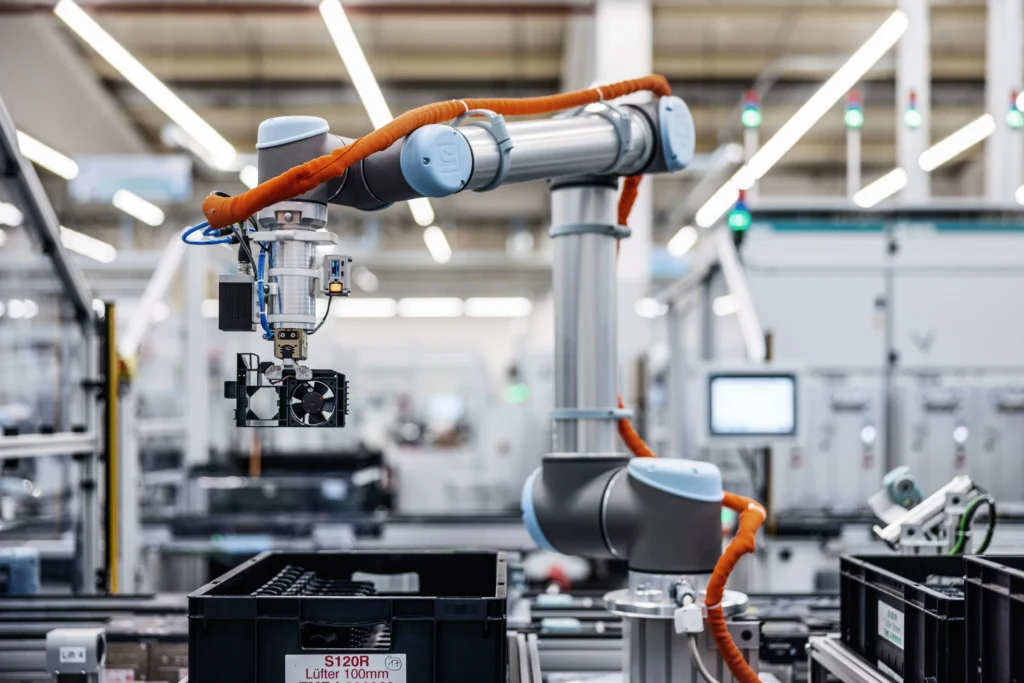
Industrial robots supporting automated handling processes at Siemens’ manufacturing facility. Source: © Siemens AG.
Why Is Digital Twin Technology Essential for AI in Manufacturing?
If AI is considered the brain of an intelligent factory, Digital Twin technology can be viewed as the environment that allows AI to understand, evaluate, and experiment with changes in the physical world.
In manufacturing, making changes directly to physical production lines always involves costs, risks, and time. Digital Twin technology creates a digital representation of a product, process, or manufacturing system, allowing companies to simulate, evaluate, and validate changes before implementing them in the real world.
The combination of AI and Digital Twin technology enables more adaptive optimization. Instead of relying solely on historical data analysis, AI can generate multiple scenarios, assess their potential impact, and identify promising options based on operational data and predefined objectives.
At the Erlangen factory, Siemens combines its industrial software and manufacturing expertise with NVIDIA technologies, including NVIDIA Cosmos for generating synthetic data used in quality inspection, NVIDIA Factory Operations Blueprint for AI agent-based planning, and NVIDIA Omniverse libraries for validating production scenarios in digital environments.
This represents an important step toward integrated manufacturing environments in which design data, simulation, and operational information are no longer isolated in separate systems.
Will Future Factories Need Fewer Engineers?
As AI becomes capable of supporting production planning, simulation, and manufacturing optimization, an important question arises: will engineers eventually be replaced?
In reality, technology is transforming the nature of engineering work. Repetitive tasks, large-scale data processing, and the evaluation of multiple design or production scenarios can increasingly be automated. However, decisions involving production objectives, quality standards, safety requirements, and practical implementation still demand engineering expertise and human oversight.
In AI-powered manufacturing environments, engineers may spend more time developing processes, validating models, assessing risks, and improving systems instead of performing repetitive manual operations.
AI is not simply replacing engineers’ tasks; it is transforming how engineers design, validate, and operate manufacturing systems.
This transformation also creates new demands for digital competencies, data-driven thinking, and closer collaboration between manufacturing engineering teams and intelligent technology systems.
What Does AI in Manufacturing Mean for Vietnamese Enterprises?
Not every manufacturer can immediately develop a fully autonomous factory. However, the progress demonstrated by Siemens and NVIDIA shows that AI in manufacturing is already being applied to specific industrial challenges.
For Vietnamese enterprises, particularly those operating in electronics, precision engineering, supporting industries, and high-tech manufacturing, AI adoption can begin by addressing familiar challenges such as fragmented engineering data, lengthy production preparation processes, extensive physical testing, or production planning that relies heavily on manual operations.
Rather than investing immediately in a fully autonomous manufacturing system, companies can establish a digital foundation step by step. This may involve standardizing design data, connecting Product Lifecycle Management (PLM) systems, adopting simulation tools, automating workflows, and implementing Digital Twins in processes where measurable value can be achieved.
Once reliable data foundations and well-defined processes are established, AI can be integrated to support analytics, forecasting, and production optimization. This gradual approach allows companies to manage investment costs while evaluating the effectiveness of each implementation stage.
What Message Are Siemens and NVIDIA Sending to the Industry?
From a technological perspective, the latest announcement demonstrates that the AI revolution is expanding rapidly into the industrial sector.
While AI was previously associated primarily with chatbots, office software, and content creation tools, industrial technology companies are now focusing on a more complex challenge: bringing AI into the physical world, where machines, production lines, logistics, quality requirements, and real-time operational pressures must all be considered.
Technologies such as Industrial AI, Physical AI, Digital Twins, and AI Agents are increasingly converging, establishing the foundation for a new generation of manufacturing systems capable of adapting more effectively to real-world changes.
For manufacturers, future competitive advantages may depend not only on owning advanced equipment, but also on their ability to leverage data, connect engineering and operational systems, and continuously improve performance through AI.
Conclusion
The latest developments announced by Siemens and NVIDIA demonstrate how AI is evolving from an analytical support tool into a technology that plays a deeper role in simulation, production planning, and manufacturing optimization.
With the potential to significantly reduce engineering preparation effort, accelerate time-to-market, and optimize manufacturing costs, the concept of autonomous factories is becoming increasingly achievable through real-world industrial applications.
In this context, the key question for manufacturers is no longer simply whether AI is useful, but where they should begin to implement AI in manufacturing in a practical, efficient, and sustainable way.
Reference: Siemens Press – Siemens partners with NVIDIA to advance AI-driven, autonomous factories (October 19, 2026).
Learn more
- Siemens EDA AI – Artificial Intelligence for IC and PCB Design
- Improving PCB Design Productivity with AI and Intelligent Automation
- HyperLynx: A Digital Twin for Electronic Design
Contact VBTECH
VBTECH supports businesses throughout their engineering digital transformation and smart manufacturing journeys, offering solutions for design, simulation, engineering data management, and technologies that help improve manufacturing efficiency.
Companies interested in industrial digital solutions are welcome to contact VBTECH for expert consultation and guidance on selecting and implementing technologies that best meet their operational requirements.
Website: https://vbtech.com.vn
Hotline: 091929 5529
Email: [email protected]